

Inquiries
Inquiries are short explorations of questions that emerge from research, practice, and ordinary human experience. These pieces look closely at situations that may seem familiar, asking what we might notice when we bring research, context, and another way of seeing them.
Some begin with communication. Others with programs, organizations, or the ways we try to understand human experience. Each starts with a question worth looking at more closely.
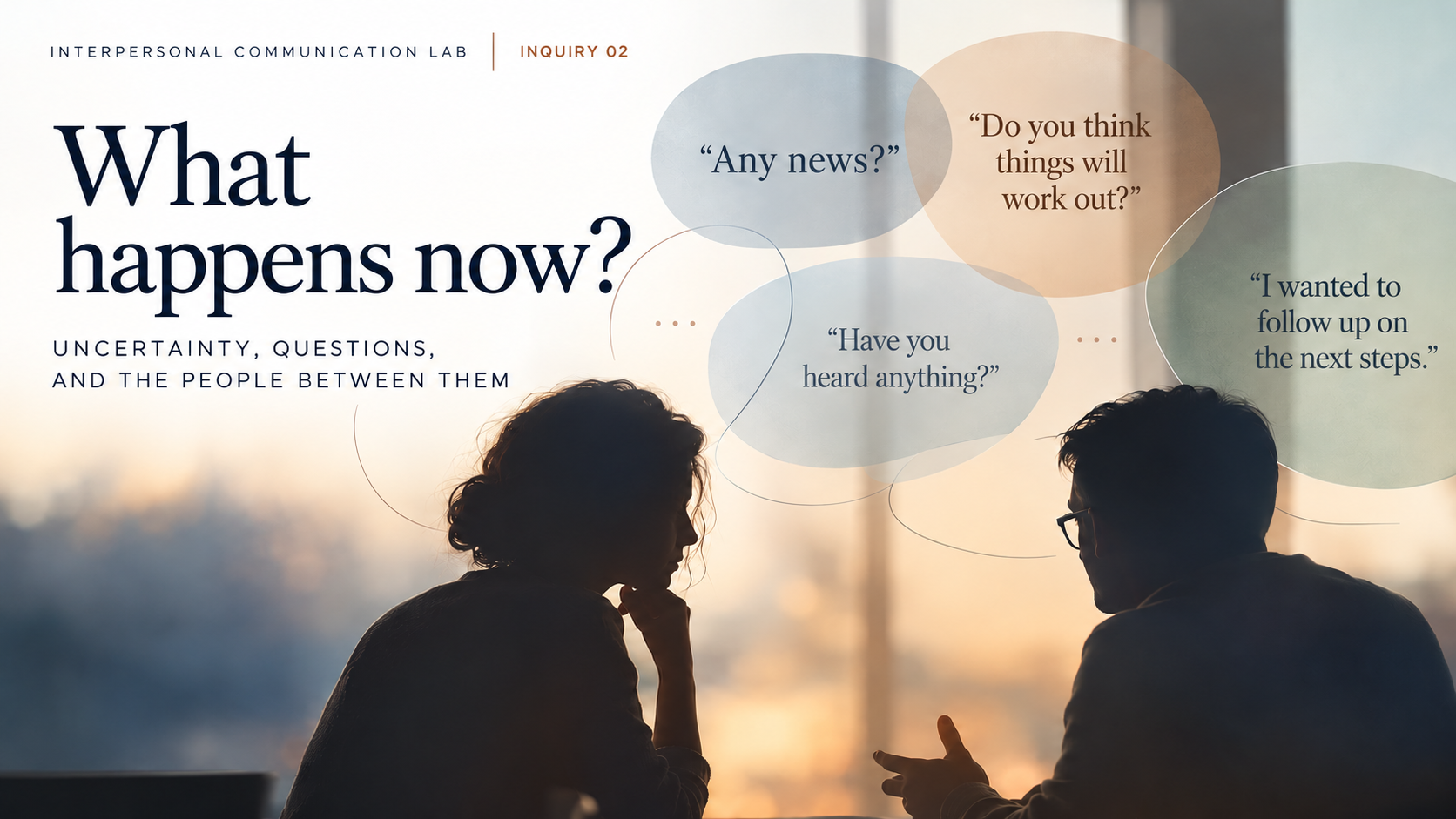
“What happens now?”
Uncertainty isn't simply an absence of information. It shapes how information, silence, questions, and responses acquire meaning between people, especially when those people have unequal access to information, authority, and control.
I've always liked the word wonder. There is something rather enticing and rosy about curiosity, and imagining what is possible. But wondering takes on a different character when the possibilities could be good, bad, and anything in between, and the outcomes have severe consequences.
Imagine wondering when you would hear back from a recruiter about a job you really need/want, after interviews that went well. Or why your boss has not replied to your project update email at a time of organizational restructuring. Or why the doctor's office is taking another day to call about your seriously ill best friend’s MRI.
We often think of uncertainty as not having enough information. Sometimes that is precisely the problem. But sometimes, we do have a great deal of information. We know what has happened, understand the possibilities, and perhaps even know what needs to happen next. What we don't know is how things will turn out.
Some people cope by being fatalistic about it. Some resort to faith. Others draw boundaries around how much of their lives, work, or sanity they will let uncertainty affect. But very few of us can wish away that thorn in our sides.
When information isn’t enough
Uncertainty can change how we interpret communication, or the lack of it. A delayed response, a curt statement, or an absence of updates can acquire enormous significance when the stakes are high. We revisit conversations, extrapolate from scraps of information, and search for clues.
Information is not bland data that gets transmitted from one person to another. What is shared — or not shared — between people in relational, professional, and all other worlds we inhabit, can be an extremely potent thing. It simmers beneath “hoping for the best,” “fearing the worst,” and “wondering” about everything in between. Sometimes, it boils over into questions or tentative follow-ups, composed while we're on tenterhooks:
“Any news?” “Do you think things will work out?” “Are you thinking what I am thinking?” “Thank you again for speaking with me last Friday. I wanted to follow up on the next steps.”
Sometimes we're looking for information to help us decide what to do. Sometimes we're seeking reassurance. Or closure. And sometimes, perhaps, asking is simply something we can do when we have very little control over what happens next.
Now let psychology gently make room for interpersonal communication.
What happens between people?
What happens between the person asking and the person being asked?
Consider a spouse caring for someone seriously ill, repeatedly asked for updates. Or a recruiter genuinely interested in a candidate but still waiting for a decision from the hiring team. Or a manager who cares for her employees, but doesn’t know what an organizational restructuring will mean for their livelihoods.
How do you respond to someone who desperately wants reassurance when you have no reliable basis for providing it?
“I'm sure everything will be fine” may communicate care and optimism, but also confidence that the circumstances don't justify. “I don't know” may be entirely honest. But is it necessarily helpful? And silence, whether prompted by an inability to share information, competing demands, or simply avoiding an uncomfortable exchange, can intensify the uncertainty for someone waiting.
Often what one person needs from the conversation isn't what the other thinks they're asking for. And often, neither of them is entirely sure.
Now consider what happens when the people involved are not similarly situated. Hello, social and I/O psychology.
The asymmetry
One person may have access to information that another does not. One may have the authority to make a decision while another must wait. A team may be unable to move forward until someone else provides a crucial information or decides what happens next.
A delay that is an administrative matter or inconvenience for one person may be a profound disruption to another's life or work.
The uncertainty may be shared, but the ability to influence what happens, and the consequences of waiting for one’s employment, health, or peace of mind , may be very different.
What does that difference do to the questions people ask, the answers they receive, and the interpretations they make? And what makes communication supportive, responsible, or even possible, when people must navigate consequential uncertainty from very different positions?
These are some of the questions worth examining in an Interpersonal Communication Lab (ICL) learning experience — whether among colleagues navigating organizational change, professionals communicating difficult information, or people trying to support others through serious illness and upheaval.
Not simply to find better or “more effective” words, but to understand the dynamics that make the thorn of uncertainty prickly.
“Let me know if you need anything.”
A sincere offer of help can ask more of the person receiving it than we realize. What happens between support that is intended and support that becomes usable?
It is one of the most familiar ways we offer support. And usually, we mean it.
Someone is grieving. Caring for a sick parent. Going through cancer treatment. Was laid off. Their marriage is falling apart. Let me know if you need anything.
It is sincere. We really do want them to reach out. We absolutely want to help. It sounds exactly right. And sometimes it is.
But what does it take for well-intended support to become usable support?
I've been thinking about what that sentence asks of the person receiving it.
To accept the offer, they first have to know what they need. If they need more than one thing, they have to determine which one to prioritize. Whether what they need is reasonable. Whether the offer was literal or simply something kind people say. Whether this is the right person to ask. How they would look asking for help — even when it was offered.
We made the offer out of kindness and politeness — but should they, could they, would they take us up on it? And if they overcome all of these doubts and decide they would, they then have to find the words.
And all the while, self-consciousness layers on top of vulnerability. A seemingly simple act of kindness is not simple when the stakes are high.
As an interpersonal communication researcher, this makes me question something we often take for granted about support: that wanting to give it and someone else needing it are enough to make the exchange work. If support is something we want to give and someone facing a challenge presumably wants to receive, why aren't offers of support automatically taken up? Why doesn't support always land as intended?
Research on supportive communication suggests a much more complicated process than a cluster of “well-intended” or “correct” phrases — or a straightforward exchange between one person offering support and another receiving it. Seeking support, offering it, accepting or refusing it, interpreting it, and ultimately experiencing it as supportive — or not — involve social-psychological and interpersonal dynamics that can complicate what looks, on the surface, like a simple exchange.
So rather than beginning with What should I say to someone who is struggling?, the question could be: What might be happening that keeps this person from asking for help? And what needs to happen for them to be able to receive support from me?
The offer, even if it comes in clichéd words, can be heartfelt. The intent matters. But so does everything in play in how the receiver interprets it, assesses it, and decides whether and how to act on it.
Understanding some of what happens in that space may help us think differently about the gap between well-intended support and support that is understood, accepted, and usable.
Interpersonal Communication Lab (ICL) examines questions like this with groups, organizations, and professional communities interested in supportive communication, grief, care, and other consequential human experiences.